But how do the mass audience choose a specific paper to read, a favourite?
Well, it is normally based on the newspapers' publishers' ideology and political views, as this generally affects the content, for example, a broadsheet, such as The Independent is more likely to be left wing, although they may not have assigned themselves to a particular party. A local newspaper would be more bias towards the smaller representatives of a party, for example, Liam Fox, a member of the Conservative party. If the paper has similar views to themselves, the individual will tend to buy and read that newspaper as opposed to one that has opinions they disagree with. Age will also affect the audience of a newspaper. Young people and children would generally feel more at home with magazines and wouldn't think about touching a newspaper, whereas those in their late teens and early 20s will be beginning to read papers, i, a compact paper would be ideal for this. The emergence of new technology has also has an impact on the younger audiences nhot reading newspapers as much as older audiences, instead they turn to the internet or the television for news.
Papers such as The Spark or The Big Issue tend to attract more of an alternative audience, mainly because of the human rights/ eco friendly type vibe, more commonly associated with left wing politics or perhaps, no politics. These papers, The Big Issue in particular, tend to be shunned by the more conventional adult, as the way it works (street vendors, usually immigrants, buy copies of the paper off of the publishers and sell them back to the public) may not be understood, or may be thought of as 'cheap' or 'charity'. Perhaps they cannot be considered a paper to some individuals, due to their subversions of newspaper conventions.A middle-aged conventional adult would be more likley to go for something like The Mercury or The Evening Post. Of course, many people may just need an update, and choose a random paper on the go, not thinking about its publisher's ideology at all.
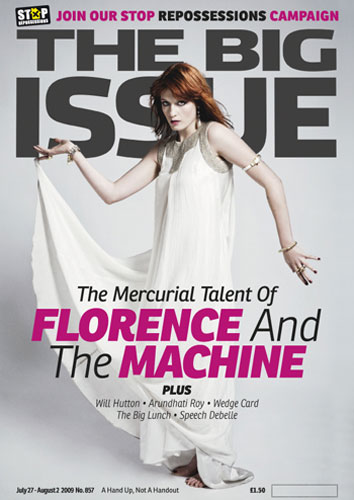 |
| The Big Issue |

No comments:
Post a Comment